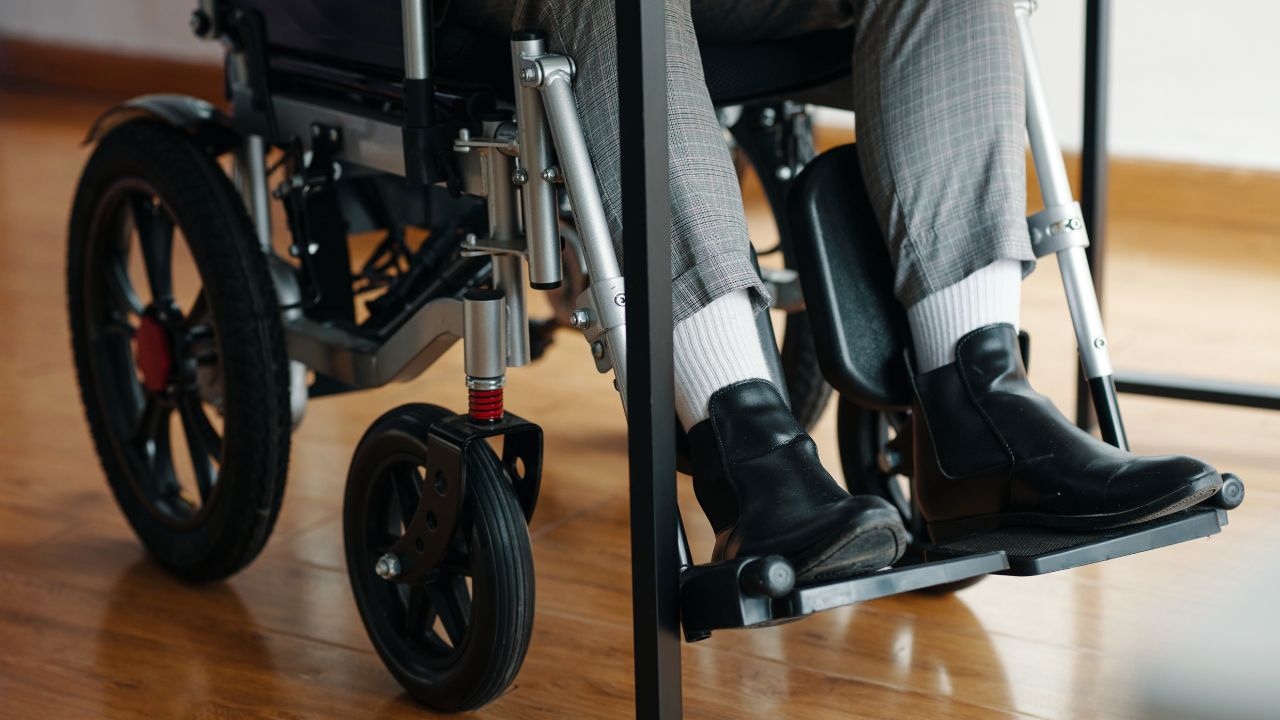
Living with both vision impairment and mobility challenges presents unique obstacles that most people never consider. Imagine trying to navigate your power wheelchair through a crowded hallway when you can’t see obstacles in your blind spots, or backing up safely when you have no visual reference points. For millions of people worldwide, this isn’t a thought experiment. It’s daily reality.
According to research from the American Federation for the Blind, approximately 9.6% of all individuals who are legally blind also use a wheelchair or scooter. An additional 5.25% of individuals who have serious difficulties seeing (but are not legally blind) also rely on wheeled mobility devices. That translates to roughly 15% of people with significant vision loss also facing mobility impairments.
This intersection of disabilities creates challenges that traditional mobility aids weren’t designed to address. Understanding these challenges and the solutions available is essential for users, caregivers, healthcare providers, and anyone committed to inclusive mobility.
The Dual Challenge: When Vision Loss Meets Mobility Impairment
Power wheelchairs are designed with the assumption that users can see their surroundings. Standard joystick controls, visual speedometers, and the entire navigation experience presume functional vision. But what happens when that assumption doesn’t hold?
People with vision impairment who use power wheelchairs face several critical challenges:
Spatial Awareness Deficits: Without clear vision, understanding your position relative to walls, doorways, furniture, and other obstacles becomes extremely difficult. What seems like a simple task for sighted users, like centering yourself in a doorway, becomes a complex problem requiring alternative sensory feedback.
Blind Spot Hazards: Every power wheelchair has blind spots, areas the user cannot easily see even with full vision. For people with vision impairment, these blind spots become dangerous zones where collisions frequently occur. Backing up is particularly hazardous without visual confirmation of what’s behind you.
Tight Space Navigation: Maneuvering through narrow hallways, crowded rooms, or between furniture requires precise spatial judgment. Vision-impaired users must rely on memory, sound cues, or physical contact with obstacles, which often means discovering barriers only after making contact.
Environmental Transitions: Moving between different environments, from indoor to outdoor spaces, across curb ramps, or through doorways, presents heightened risks. Detecting elevation changes, slope variations, or drop-offs without vision requires exceptional awareness.
Speed and Timing Challenges: Crossing streets, navigating pedestrian areas, or traveling in spaces with moving obstacles requires quick visual assessment and reaction. Vision-impaired power wheelchair users must develop alternative strategies for these time-sensitive situations.
Research on orientation and mobility for wheelchair users with visual impairment emphasizes that safety is the paramount concern. As one Certified Orientation and Mobility Specialist noted, “If anybody gets any one thing out of this, it’s keeping somebody safe. That’s probably the most important task we have.”
Traditional Navigation Methods and Their Limitations
People with vision impairment who use power wheelchairs have historically relied on several adaptive strategies:
White Cane Techniques: Some legally blind power wheelchair users employ modified white cane techniques while seated, using the cane to detect obstacles ahead. However, this approach has significant limitations. The user must operate the wheelchair with one hand while sweeping the cane with the other, reducing control and increasing cognitive load. Additionally, canes cannot effectively detect obstacles to the sides or rear of the wheelchair.
Auditory Cues: Listening for echoes, environmental sounds, and spatial acoustics helps some users understand their surroundings. While valuable, auditory navigation alone provides limited information about obstacle proximity and cannot reliably prevent collisions, especially in noisy environments.
Sighted Guides: Many vision-impaired wheelchair users depend on sighted companions for safe navigation. While this approach maximizes safety, it fundamentally compromises independence, one of the primary benefits power wheelchairs are meant to provide.
Memory and Mental Mapping: In familiar environments, users develop detailed mental maps based on memory and routine. This works reasonably well at home but fails in unfamiliar locations or when environments change unexpectedly.
Physical Contact Navigation: Some users rely on gentle contact with walls or furniture to maintain orientation, essentially “trailing” with their wheelchair instead of a hand. This method risks damage to both the wheelchair and surroundings and doesn’t prevent more serious collisions.
The reality is that none of these traditional methods adequately address the safety challenges vision-impaired power wheelchair users face, particularly in dynamic or unfamiliar environments.
The Technology Gap in Accessible Mobility
Despite decades of advancement in both power wheelchair technology and assistive devices for the blind, the intersection of these two fields remains underdeveloped. Most power wheelchairs lack built-in features specifically designed for vision-impaired users.
Standard power wheelchair features that assume functional vision include visual speedometers, battery indicators without tactile or audio components, and navigation systems requiring visual interpretation. Meanwhile, assistive technologies for people with vision impairment, such as GPS navigation apps and electronic travel aids, are typically designed for pedestrians, not wheelchair users.
This technology gap leaves vision-impaired power wheelchair users in a difficult position. They need the independence that power mobility provides, yet the safety features necessary for confident navigation without vision simply aren’t standard equipment.
Studies on navigation assistance systems for power wheelchairs have demonstrated that sensor-based collision avoidance technology can significantly reduce accidents for vision-impaired users. Research published in the Journal of Rehabilitation Research & Development showed that semiautonomous navigation assistance systems improved safety while maintaining user control and independence.
Multi-Modal Alerts: The Key to Safe Navigation
The solution to safe power wheelchair navigation for vision-impaired users lies in multi-modal feedback systems that don’t rely solely on visual information. Multi-modal alerts use multiple sensory channels simultaneously, typically combining:
Auditory Alerts: Sound-based warnings that indicate obstacle proximity through varying tones, volumes, or patterns. Different sounds can communicate different types of hazards, distance information, and directional cues.
Tactile/Vibration Feedback: Physical vibrations that users can feel, providing obstacle information through haptic sensation. Vibration intensity, pattern, and location can convey rich navigational information without requiring vision or hearing.
Visual Indicators: For users with partial vision or low vision, visual cues like flashing lights still provide valuable supplementary information when combined with other alert types.
The power of multi-modal systems is their redundancy and accessibility. A user who is deaf-blind might rely primarily on vibration, while someone with low vision might use a combination of visual and auditory cues. The system adapts to individual sensory capabilities rather than requiring users to adapt to a single feedback method.
Research on blind spot sensor systems for power wheelchairs found that multi-modal alerts not only improved obstacle detection accuracy but also reduced cognitive task load. Users could navigate more safely while expending less mental effort, leading to less fatigue during extended wheelchair use.
Real-World Success Stories
The effectiveness of assistive navigation technology for vision-impaired wheelchair users isn’t just theoretical. Real users have experienced life-changing improvements in independence and safety.
Consider the experience shared by one legally blind U.S. Marine Corps veteran who uses a power wheelchair. He described running into a child’s stroller because he couldn’t see it, saying “The kid was alright, but it scared me.” After implementing sensor-based obstacle detection with auditory and vibration alerts, he reported feeling significantly more mobile, safe, and secure in both home and community settings.
Another power wheelchair user with vision impairment shared that sensor feedback helped him align properly in doorways and corridors, allowing him to navigate tight spaces independently that previously required sighted assistance. The technology didn’t make him dependent on automation; rather, it provided the spatial awareness information his vision couldn’t supply, keeping him fully in control while enhancing safety.
These stories illustrate a crucial point: the goal of assistive navigation technology isn’t to replace user skill or judgment but to provide the environmental information that vision normally supplies, enabling truly independent mobility.
Navigotech: Multi-Modal Safety for Vision-Impaired Wheelchair Users
At Navigotech, we understand that safety technology must work for users across the full spectrum of sensory abilities. Our blind spot sensor system was specifically designed with vision-impaired power wheelchair users in mind, offering comprehensive multi-modal alerts that don’t depend on functional vision.
Unlike basic proximity sensors that only beep when obstacles are detected, Navigotech’s system provides:
Customizable Alert Combinations: Users can choose which feedback methods work best for their sensory abilities. Rely solely on vibration if you’re deaf-blind, use primarily auditory cues if you have some functional vision, or combine all three alert types for maximum awareness.
Directional Spatial Information: Our system doesn’t just warn you that an obstacle exists, it provides directional information so you know where the hazard is located relative to your wheelchair. This allows for informed navigation decisions rather than just generic warnings.
Real-Time Navigation Guidance: Beyond simple alerts, Navigotech offers on-screen navigation instructions that can be paired with screen reader technology for vision-impaired users, or used by caregivers and rehabilitation specialists during training.
Adaptability for Alternative Drive Controls: Many vision-impaired power wheelchair users operate their chairs using alternative control methods like sip-and-puff systems or head arrays. Navigotech integrates seamlessly with these control systems, providing crucial spatial awareness without interfering with your preferred driving method.
The system works just as effectively for users with vision impairment as it does for sighted users, because it fundamentally changes how environmental information is delivered. Instead of requiring you to see obstacles, Navigotech communicates spatial information through the sensory channels that work best for you.
As highlighted in our discussion of why safety features should be standard, advanced protection shouldn’t be limited to top-tier wheelchairs or users with full sensory capabilities. Safety is a fundamental right for all wheelchair users, regardless of their vision status or the classification of their mobility device.
Creating a More Accessible Future
The challenges vision-impaired power wheelchair users face highlight a broader need within the mobility industry: truly universal design that accounts for diverse sensory and physical abilities. As our population ages and the prevalence of both vision impairment and mobility challenges increases, solutions that serve users with multiple disabilities will become increasingly essential.
Technology exists to make power wheelchair navigation safe and independent for vision-impaired users. The question is whether we, as a society, will prioritize making these solutions accessible and standard rather than treating them as expensive add-ons.
For vision-impaired individuals considering power mobility, know that technology can provide the spatial awareness you need to navigate confidently. For healthcare providers and rehabilitation specialists, advocating for appropriate assistive navigation technology should be part of comprehensive power wheelchair prescriptions for vision-impaired patients.
Independence and safety aren’t mutually exclusive, even when you’re navigating a visual world without sight.